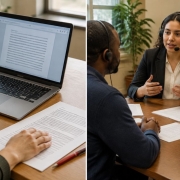
Is an Interpreter Needed at the IEP Meeting?
/0 Comments/in Interpreter /by Sandra LedesmaIs an Interpreter Needed at the IEP Meeting
Yes. If you are deaf or your native language is not English, your school district must arrange an interpreter for your child’s IEP meeting, at no cost to you. This right comes from the Individuals with Disabilities Education Act (IDEA), and federal civil rights law adds further protections.
At Spectrum Translations, our founder Sandra Ledesma is a California Certified Court Interpreter who has interpreted hundreds of IEP meetings since 2008. This guide explains what the law requires, who can and cannot interpret, how to request an interpreter, and what to do if the school does not provide one.
What the Law Says About Interpreters at IEP Meetings
Under IDEA, the school must take whatever action is necessary to make sure you understand what happens at the IEP meeting. That includes arranging an interpreter for parents who are deaf or whose native language is not English, as stated in 34 CFR §300.322(e).
A second law applies too. Title VI of the Civil Rights Act requires districts that receive federal funds to give parents with limited English proficiency meaningful access to school information. The Office of Special Education Programs has made clear that IDEA does not replace these Title VI obligations.
Your right | Legal source | What it means for you |
|---|---|---|
An interpreter at the IEP meeting | The school arranges the interpreter so you can follow and take part in the meeting. | |
Notices in your native language | 34 CFR §300.503(c) and §300.504(d) | Prior written notice and procedural safeguards must reach you in your language, unless that is clearly not feasible. |
Access to the IEP itself | Title VI; 2016 OSEP communication | The IEP is a vital document. The school must make it accessible to you, often through a written translation. |
Qualified language help | Schools may not rely on children or untrained staff to interpret for you. |
Do I Have to Pay for the Interpreter?
No. The interpreter is part of the school’s obligation to include you in the IEP process, so the district arranges and pays for it. You are a full member of your child’s IEP team, as explained in what an IEP is and how it works, and the law protects your ability to take part.
Who Can Interpret at an IEP Meeting
Not everyone who speaks two languages can interpret an IEP meeting. Federal guidance and state education agencies point to the same rules:
- Not your child or other children. Schools should not ask students, siblings, or young relatives to interpret, even if they speak both languages well.
- Not untrained bilingual staff. Being bilingual is not the same as being qualified to interpret. A teacher or aide who speaks Spanish may help you in daily conversations, but an IEP meeting needs a trained interpreter.
- A qualified interpreter. A qualified interpreter is fluent in both languages, knows special education terms, interprets everything that is said without summarizing or adding opinions, and keeps your family’s information confidential.
- A sign language interpreter for deaf parents. The same right covers parents who are deaf or hard of hearing.
You may still bring a bilingual relative or friend for support. The district’s trained interpreter should remain the official interpreter for the meeting. To learn what separates a professional from a bilingual helper, read why professional interpreters are critical for IEP meetings.
How to Request an Interpreter for Your Child’s IEP Meeting
The school must provide an interpreter, but it needs to know you need one. These steps help make sure one is there:
- Tell the school as soon as you receive the meeting notice. Ask how much advance notice they need to schedule an interpreter.
- Put your request in writing. An email creates a record. Name the language you need, such as Spanish or American Sign Language.
- Ask for the interpreter for the whole meeting. The interpreter can join in person or by video, but should stay until the meeting ends.
- Ask for documents before the meeting. Request the draft IEP and any evaluation reports so you have time to review them.
- Ask about a written translation. Interpretation covers the meeting. Ask how and when you will receive the IEP in your language.
You can copy and adapt this message:
Sample request (English)
Hello [name], I received the notice for my child [child’s name]’s IEP meeting on [date]. My primary language is Spanish, and I am requesting a qualified Spanish interpreter for the full meeting. Please also send me the draft IEP and any evaluation reports before the meeting. Thank you, [your name]
Mensaje de ejemplo (español)
Hola [nombre]: Recibí el aviso de la junta del IEP de mi hijo/a [nombre del niño] para el [fecha]. Mi idioma principal es el español y solicito un intérprete calificado de español durante toda la junta. También les pido que me envíen el borrador del IEP y los reportes de evaluación antes de la junta. Gracias, [su nombre]
What to Expect During an Interpreted IEP Meeting
An interpreted meeting follows the same agenda as any IEP meeting, with a few differences:
- It takes longer. Everything is said twice, so state guidance suggests planning for about double the usual time.
- The interpreter works consecutively or simultaneously. In consecutive interpretation, the speaker pauses so the interpreter can repeat the message. In simultaneous interpretation, the interpreter speaks at the same time, often through headsets.
- The team should speak to you, not to the interpreter. Staff should look at you, speak one at a time, and pause often.
- You can stop the meeting to ask questions. If a term or acronym is unclear, ask. Our guide to special education acronyms every parent should know includes the Spanish equivalents of the most common ones.
- You do not have to sign at the meeting. You can ask for time to review the IEP, or for a translated copy, before you sign.
What to Do If the School Does Not Provide an Interpreter
If no interpreter arrives, or the school offers a child or untrained staff member instead, you have options:
- Ask to reschedule. You can say you cannot participate meaningfully without a qualified interpreter.
- Write to the special education director. Describe what happened and ask for a new meeting date with an interpreter.
- Get free help. Your state’s Parent Training and Information Center can advise you at no cost.
- File a complaint. You can file a state complaint with your state education agency, or a civil rights complaint with the U.S. Department of Education’s Office for Civil Rights.
State laws can add rights. In California, parents are entitled to a free interpreter at IEP meetings under Education Code §56341.5(i), and to a free copy of the IEP in their primary language under California Code of Regulations, Title 5, §3040(a), according to Disability Rights California. In Texas, the same right applies at ARD meetings, the Texas name for IEP meetings. For a broader view of your protections, see our guide to IDEA for Spanish-speaking families.
Interpretation for the Meeting, Translation for the Documents
An interpreter makes the conversation understandable, but the IEP is a written plan you will use all year. Many families need both: an interpreter at the meeting and an accurate written translation of the IEP and evaluation reports afterward.
Spectrum Translations provides English–Spanish interpretation for IEP, ARD, and 504 meetings, on-site or by Zoom or phone, along with IEP Spanish translation and translation of other special education documents. Schools that need ongoing support can learn about our school district translation services. To arrange an interpreter or translation, request a free quote and tell us your meeting date.
Frequently Asked Questions
Does the school have to provide an interpreter at an IEP meeting?
Yes. Under IDEA, the school must arrange an interpreter for parents who are deaf or whose native language is not English, so they can understand and take part in the meeting.
Can my child or a family member interpret at the IEP meeting?
Schools should not rely on children or untrained relatives to interpret. You may bring a bilingual family member for support, but the official interpreter should be a qualified interpreter arranged by the district.
Do I have to pay for an IEP meeting interpreter?
No. The school district arranges and pays for the interpreter at no cost to you.
Can the interpreter join the IEP meeting by phone or video?
Yes. IEP meetings and interpreters can take place by video conference or phone when the parent and the school agree. What matters is that you can hear and follow everything that is said.
Does the school have to translate the IEP into Spanish?
Often, yes. The U.S. Departments of Education and Justice treat the IEP as a vital document that must be accessible to parents with limited English proficiency. Some states, such as California, give parents the right to a free copy of the IEP in their primary language.
What is the difference between an interpreter and a translator?
An interpreter works with spoken or signed language in real time, such as during an IEP meeting. A translator works with written documents, such as the IEP, evaluation reports, and notices.