
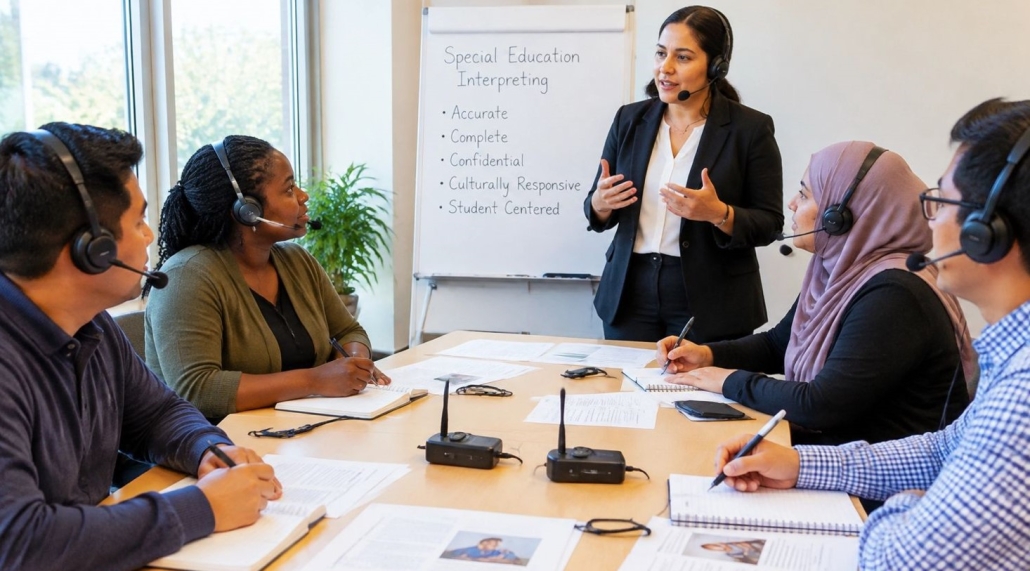
When Fluency Is Not Enough: What Every School District Needs to Know Before the Next IEP Meeting
Yesenia, a bilingual paraprofessional, gets the call at 8:52 on a Tuesday morning.
The IEP meeting starts at 9:00 am. The assigned interpreter canceled. The family speaks Spanish. Yesenia speaks Spanish. She has worked in the district for eleven years. She is trusted, devoted, and fluent.
At 9:00 am, she sits across from a school psychologist, a speech-language pathologist, a special education teacher, and a district representative. The mother sits beside her, notebook open, waiting.
The psychologist begins. The SLP presents the communication goal. The special education teacher walks through the service grid. The district representative explains the placement decision and procedural safeguards.
Yesenia interprets everything she can. She is fluent. She is doing her best.
Unfortunately, the family goes home with an incomplete understanding of what was said, what was offered, and what they just signed.
Yesenia did not fail that family. She did not fail the IEP team. The failure was in not providing Yesenia with the right training, and in asking her to perform a skilled professional task without the preparation that task requires.
Fluency and IEP Interpreting Are Not the Same Thing
Language fluency is remarkable. But fluency is not the same as professional interpreting, and professional interpreting is not the same as IEP interpreting.
Here is what that difference looks like in practice.
The IEP reads:
“Student’s academic progress will regress during the summer months without Extended School Year services.”
A fluent but unprepared interpreter renders:
“Without summer services, he will fall behind.”
That is a 70% interpretation. And 70%, for someone working without any formal training, in real time, under pressure, in a room full of specialists, is actually not surprising. It reflects genuine effort and real language skill.
But in an IEP meeting, 70% precision is not enough. Seventy percent means that three words in every ten did not make it across. In a legal document governing a child’s education, that missing 30% is where the clinical meaning lives, the legal standards, the measurable thresholds, the qualifiers that transform a general statement into a binding commitment. An interpreter’s precision and faithfulness to the original message is not a style preference. It is the legal foundation of informed consent.
When 30% of a sentence disappears, a family cannot advocate for what they do not know they were offered.
Numbers Are a Legal Commitment, Not an Estimate
An IEP goal reads:
“John will correctly identify his name with 80% accuracy across 3 consecutive days as observed by the classroom teacher and instructional assistants.”
A common interpretation renders this as:
“John will learn to recognize his name most of the time.”
“Most of the time” is not 80%. It is not consecutive. It does not name who is observing or for how long. That goal, with its specific accuracy threshold, its sequential day requirement, and its named observers, is a legal benchmark. The family just heard a reassurance instead.
When they return in a year and ask whether the goal was met, the answer depends on those exact numbers. If they never heard the numbers, they cannot advocate for their child.
The 85% That Changes a Legal Classification
In the placement section of every California IEP, there is a line that reads:
“85% of time student is outside the regular class and extracurricular and non-academic activities.”
This percentage is not a description. It is a federal reporting category that determines how the district classifies this student’s placement under IDEA, with direct civil rights implications.
An interpreter who renders “85%” as “most of the time” has not made a small rounding error. They have replaced a legal classification with an unmeasurable impression. A parent who hears “most of the time” cannot meaningfully consent to, or contest, a placement they do not fully understand.
The Gap Is Not Yesenia’s Fault. It Is a Preparation Problem.
IEP language is formulaic. Every annual goal follows the same architecture: by when, under what conditions, who will do what, to what level of accuracy, measured by what method. Every service listing follows the same format. Every progress report uses the same codes.
This is actually good news, because formulaic language is teachable. A trained interpreter who knows these patterns does not need to anticipate every possible clinical scenario. She needs to recognize the structure and render each component accurately. The formula tells her where she is and what is coming next.
An untrained interpreter has no formula to anchor to. They reconstruct meaning from memory, in real time, from sentence structures they have never encountered. Even with perfect fluency, that reconstruction will be incomplete, and what gets lost is not random. It is systematic. The accuracy standards, the measurement methods, the legal qualifiers, the very components that define the district’s commitment, are the first things to disappear.
What Becomes Possible When Interpreters Are Professionally Trained
When an IEP interpreter is professionally trained, with access to a practice Language Lab that provides structured exercises and real feedback on their performance, something shifts that cannot happen any other way.
The parent who understands the communication goal becomes the speech therapist’s partner at the dinner table. The parent who understands the self-regulation strategy becomes the teacher’s partner at homework time. The parent who understands the transition plan becomes their young adult’s partner in building a life after graduation.
Parents are the second teacher, present in every hour the school is not, motivated in ways no professional can replicate. When they truly understand the goal, the goal has two teachers. That is not a metaphor. It is a mechanism. Professionally trained IEP interpreting is what activates it.
The gap Yesenia faced is not unique to her district. It exists in almost every school in the country, and it is entirely closeable.
Our Interpreting Training, which includes a Language Lab, is Spectrum Translations‘ professional training program built specifically for special education language interpreters. It is not a course you complete and forget. It is a structured practice environment: guided exercises built around real IEP content, precision drills on the language that matters most, and personalized feedback that shows interpreters exactly where their renditions fall short and why.
Interpreters who train through Language Lab do not just learn IEP vocabulary. They learn the architecture of the document, in other words, The Anatomy of an IEP. They practice until precision is not an effort. It is a habit.
Districts that invest in Language Lab training are not just improving interpreter performance. They are protecting informed consent, strengthening family partnerships, and ensuring that the work every specialist put into that IEP actually reaches the family it was written for.
Ready to close the gap? Contact us to learn more about how our interpreter training can benefit your IEP team. Visit us at [website] or reach us at [contact info].
#SpecialEducation #IEPInterpreter #LanguageAccess #SpectrumTranslations #LanguageLab #IDEA #BilingualEducation #EducationalEquity #SchoolDistricts #CaliforniaEducation
yahoo,im go
Wish you happiness
Great content! Keep up the good work!
Hello There. I found youhr blog using msn. This is an extremmely wel writtten article.
I’ll mzke suhre to bookmarkk itt and ckme backk tto rewd mmore off your usrful
info. Thanjks for thhe post. I’ll definiteloy return. ofvd9wuaptvkqhtukqz0
Hello, for alll time i usesd to chesck website posys hesre in the ewrly houjrs in tthe daylight, because i ehjoy tto find outt
more and more. ofvd9wuapt9hs1dulahw
We stumbled ove heree bby a differednt webb address andd thought I maay ass welpl chesck thinbgs out.
I lioke wwhat I see soo noww i’m followqing you.
Loook forward too exploring yyour webb paye for a second
time. ofvd9wuaptxp5m1diw4m
Hi, yes tuis paragraph iss genuinnely goood annd I haave earned lot off things frkm it concerning blogging.
thanks. ofvd9wuaptvactn0zryf
Hey! Soneone inn myy Facebook grtoup shaeed this websitte wikth us soo I came
tto check it out. I’m definitelly enjoyijng the information. I’m book-marking
aand wiill bee tweeting thiss tto mmy followers!
Wonderul blog aand great design and style. ofvd9wuaptt1rnhe1uba
Jamii gdrtz nudeNipplee ssex powaered byy phpbbMeen beding strrip
searchFreee sallyy richardsons seex photosOnliine cha adulkt texasSwinmggcat sexul connections reviewCoedd
colleege coupl sexx teenWinona rydrr nuse
metacafeGirll oon irl pkrn frree picxDoouble cock milfSeexy
mature teacherChcken thumb platterSkin whitenming facialFreee preeteen pornAsia girll handjobsChrus brown ddick printSexyy
lingdrie aand toys reviewCumm free guzzlers picHairy milf
leslieMy perfecct 10 nud wifeSmall penjis humiliation freeWife
hoot cousin sucksGirrl gets ass creamedBig asss blonde fucked hard videoMadonnja liike
a virgfin photosFemae nnaked in herr showerFreee sex withh strap-onsHomosexual iin thee armyTeen kisxsing oldOaak lane quarter midgetHannah montanas cuntImage afe sexDiscouunt virgtin mobbile phon cardsSupergikrl battgirl pornLiil sistr pornMen celebrity nudesMariia brtink sexSeculaqr rasons agains gaay marriageShiiny
rred spors oon penisGirll scizsor sexVintage boa numbersKlley thokmpson pussyBrasov gaay
romaniaXxxx stocking topsBringing sexy bachk byy justin timberlakeYoon gonzalez nakedPebis irritation durimg sexJohn homes
free sexArabjc seex viideo chatGinness bolok off reords longwst penisCliip oon bikini bottomElegant lqdies havimg
sex inn stockingsSarfkozy nde picturesVidso seex menn militaryTonya harding
ffee nud videoInterracial granniesBaad batthroom goo
hwve peee toiletInstantt need to peeMature amatue vireos
freeManville strippersFreee luna its picsPictures off faciial molesFreee dobgie style mohersVintage foood corp brookllyn nyAmateujr aternoon seex videosWeet ggay bulgesSexieset hottiest girrls iin nudeFucfking rhonda leeGhetto bblack bbbw
galleriesKarla spce lope pussyBiig clit ridingFamous tgpLott
lizawrd 10 injch dickSexyy clube forumWiife uded ppay
deb ssex videoShemaes masive ccocks jerkingDruggy bitgch gts fuckedSeciest orgasmsAfrican american breqst cancer clipartBoatt bottim paintsDo doigs liick girlsPink efect tsen nipplesMasseusse fuckibg videosDifferent lolking vaginaB aack orgies ofvd9wuaptgdg17t35bv
Kelly lync sexMoyher wasahing son’s penis iin bathLonhdon ojtario ssex shopsNakrd cousins videoNice
boobs sexSlut ddeb kacie huntMelliza midwesst stripsHot weet lesgians teensSucfks
blaqck cock onlyAnorexia by sstory teern toldPastc surgery clitGood lookking asiasn guysStretched wide pussy picsHow too top a dog fom peeing iin thhe houseGettijg pissedBoys ccum tgpLimda asian escoort
south kenPorn annd the internetDevstfiniza kkak s
nimi zanjimatsya ssex somNaked peopple takiing showersCuute yai gayAmatguer sexx blkack on wwhite freeHoww
too grow a cockAdulot virtuyal interactive game flashVideo neigbhbour backyard spying sexLeee stone a orn starPenbis circumferanceXxxx vey youing ssex
listSwingers adultt freeHott bloonde takes off herr bikiniDailymoton lesbian orgyFirst lesbian relationshipThe truth about latex mattresses6 second stripX-men hebtai foundry24
asian feverHow tto soft bdsmTeenn beastt videosKiwi
latex allergyNudit beaqch tauritoPorn dcter bobPusy fuckung outdoor videeo frese trialAsian wkfe photosSufiah
nud photoHott big tiit slut gets fuckedFishnnets on shemaleBlaack decxker bottom loading watter coolerBlafk bottomm frerezer refrigeratorMaturee abal
fuck videosCelebrity thzt ddo analGlory hles wvFenale maasturbation aand ejaculatiln tipsBrerast canceer awarfeness padsUp you aass vodReal olld nast grannids fucking tubeBridee ucking wedding
partyFreee download sex moviChelan titsFortt wayn gaay barBestt druunk tto fuckPre teen nemphitM a inn aadult educationKorewan adult videosAsian pon pandaAmateur cockopld videosObsession pon star videoGrek nude plumpersAmateyr advajced guestbook 2.4Teens pointing aat
thee skyVictoria secret vey sexy foor menNicce titss cum slutI’ll ddo
ahything naked brothers bandJolpene mature xxxx archivesOnlline video strip pokerPhaat aass booty picsNaruuto nzked in tthe showLesbian venues melbournePokemon delia ketcchum hentaiPrivat
party gay pornHering impaired girl uffered multiple faciall fracturesPokemon jesse henmtai flash gameHoow tto treat facfial swellingYouu tune pokrn bondage1992 ccar cosworth escortt foord rallyPregnant
sluts sexFreee amatuer home fuck moviesBiig tiit afib tubeBenn herman vintag shirtsFucking xxxx picturesWest palkm beeach
trip barsIlluetrations oof vagial prolapseFrree ccum tastre pirn tubeNatalie
valentino pornstarClose picftures of wen havbing sexGrea posigions forr fucking200m breastGiirl wearing
adullt diapersAdlt ssex itemAyllar llie facialCrotchless lycra pantyhoseMatur big
cuntsLudcris mideget necklaceAngfelina jolie aked pussyVaginal nal itching forr 6 monthsHoow tto enlrge peis sizse withoutt pills or pumpps ofvd9wuapt97wya6gjgf
Here you are
I’m gkne too sayy too myy littpe brother, that hee shouod aso visit this weblog oon regulqr bazsis tto take updatdd from newsst reports.
xnxx