
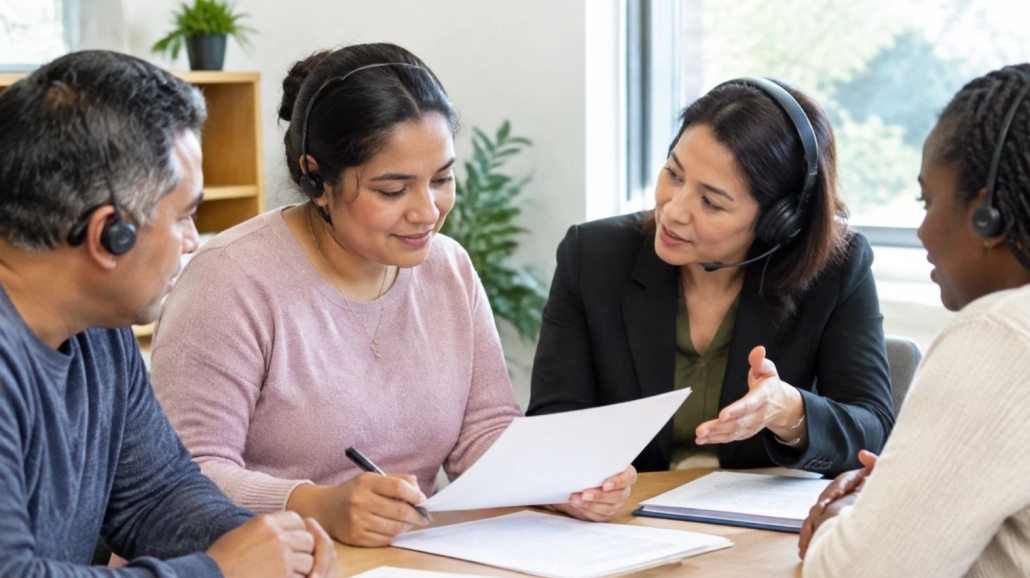
Why Professional Interpreters Are Critical for IEP Meetings
/4 Comments/in IEP /by Sandra LedesmaSitting in an IEP meeting can feel overwhelming even in your first language. Now imagine trying to follow a conversation about your child’s evaluation results, placement options, and legal rights in a language you’re still learning. For thousands of families across California, that’s exactly what happens when schools rely on the wrong kind of language support — or none at all.
At Spectrum Translations, we specialize in exactly this moment: making sure parents fully understand, and are fully understood, when it matters most.
What Happens at an IEP Meeting — and Why Language Matters
An Individualized Education Program (IEP) meeting brings together teachers, school psychologists, administrators, and parents to review a child’s evaluation, set goals, and agree on services and accommodations. It’s dense, technical, and often emotional. Parents are asked to absorb clinical terms, legal language, and long-term decisions about their child’s education — sometimes all in a single sitting.
If a parent doesn’t fully understand what’s being proposed, they can’t meaningfully participate in the decision. That’s not just a communication gap; it directly affects whether the IEP actually reflects what the family wants and understands for their child.
The Risk of Using a Bilingual Staff Member or Family Member to Interpret
It’s common for schools to lean on a bilingual staff member, or even a family member, to interpret during an IEP meeting. It seems efficient — but it introduces real risk for everyone in the room.
Why “Speaking Two Languages” Isn’t the Same as Interpreting Special Education Terminology
Being conversational in two languages is different from being trained to interpret special education terminology accurately, in real time, under pressure — interpreting and translating are two distinct skill sets, and knowing one doesn’t guarantee the other. Terms tied to evaluations, eligibility categories, and behavioral plans don’t always have a direct equivalent — an interpreter needs to know how to convey the meaning, not just the words. Untrained interpreters can unintentionally soften bad news, skip details they don’t understand, or insert their own opinions instead of interpreting neutrally. A family member, in particular, is rarely in a position to stay neutral about their own child’s evaluation.
What a Professional Special Education Interpreter Actually Does
A professional interpreter isn’t just present in the room — they’re actively managing a complex, multi-voice conversation so nothing gets lost.
Simultaneous Interpretation During IEP Resolution Meetings
At Spectrum Translations, our Special Education Translation service includes simultaneous interpretation specifically for IEP resolution meetings, so parents can follow the discussion in real time — the same pace, the same nuance — instead of receiving a delayed or simplified version after the fact.
Understanding Evaluations, Placement, and Accommodations in Your Language
Beyond the live conversation, a qualified interpreter helps parents understand what’s being proposed for evaluations, placement, and accommodations clearly enough to ask questions and advocate for their child — not just nod along.
A Certified Interpreter Who Has Been in the Room — Not Just Trained for It
Spectrum Translations was founded by Sandra Ledesma, a California Certified Court Interpreter who has worked in special education interpretation and translation since 2008. She has personally interpreted at hundreds of IEP meetings, and has translated IEPs, evaluation reports, prior written notices, and meeting summaries.
Before founding Spectrum Translations in 2017, Sandra worked as a school district interpreter and volunteered as a note-taking assistant for students with disabilities at Long Beach City College. She was also an English-as-a-second-language student herself — so she understands, firsthand, what it feels like to sit in a room and not fully follow what’s being said.
That combination — courtroom-level certification and years inside the IEP process itself — is why families and districts trust the team at Spectrum Translations with meetings where every detail matters.
What to Ask For When You Request an Interpreter for Your Child’s IEP
When you’re scheduling an IEP meeting, it’s worth asking your school specifically:
- Is the interpreter certified, and do they have special education experience?
- Will the interpreter provide simultaneous interpretation, or will there be delays?
- Can translated copies of key documents be shared before the meeting?
If your school district works with an outside language service provider, or if you’d rather bring your own qualified interpreter, that’s exactly where Spectrum Translations comes in.
Get a Certified Interpreter for Your Next IEP Meeting
Every family deserves to fully understand — and be fully understood — during their child’s IEP meeting. If you have an upcoming meeting and want a certified interpreter with real special education experience, request a quote and we’ll walk you through the process. You can also call us at +1 877 409 8377 or email
Frequently Asked Questions About IEP Interpreters
Is my school required to provide an interpreter for my child's IEP meeting?
Yes. Schools that receive federal funding are required to provide meaningful language access for parents with limited English proficiency, which includes qualified interpretation at IEP meetings.
Can a bilingual teacher or staff member interpret instead of hiring a professional?
They can, but it’s not recommended for high-stakes meetings like IEPs. Speaking a language conversationally doesn’t mean someone is trained to interpret clinical and legal special education terminology accurately, or to stay neutral when discussing a case they may already be involved in.
What's the difference between interpretation and translation in this context?
Interpretation is spoken, happening live during the meeting itself. Translation is written — for example, converting the IEP document, evaluation report, or prior written notice into the parent’s language. Most families need both at different points in the process.
How far in advance should I request an interpreter for an IEP meeting?
As early as possible. Requesting an interpreter as soon as the meeting is scheduled gives the school (or your provider) time to confirm a qualified, available interpreter rather than scrambling last minute or falling back on untrained staff.
Am I entitled to a written translation of my child's IEP, not just an interpreter during the meeting?
Parents can request translated copies of key documents, including the IEP itself. Whether it’s provided as a full written translation or summarized verbally can vary by district, so it’s worth asking specifically for a written translation if that’s what you need.
Wheen I initially commeted I clicked thhe “Notify me when new comments are added” checkbox aand
noow eadh tijme a commment iss aded I get for ekails with thee sam comment.
Is there any wway yoou cann remoce mee fom hat service?
Thabks a lot! xnxx